
 English
 Bahasa Indonesia
 Tiếng Việt
 Español
 Français
 Deutsch
 العربية
 Português
Order Blocks Explained: How to Find and Trade Them
Note: this replaces two overlapping live posts with one canonical.
 Theo ToussaintHead of Trading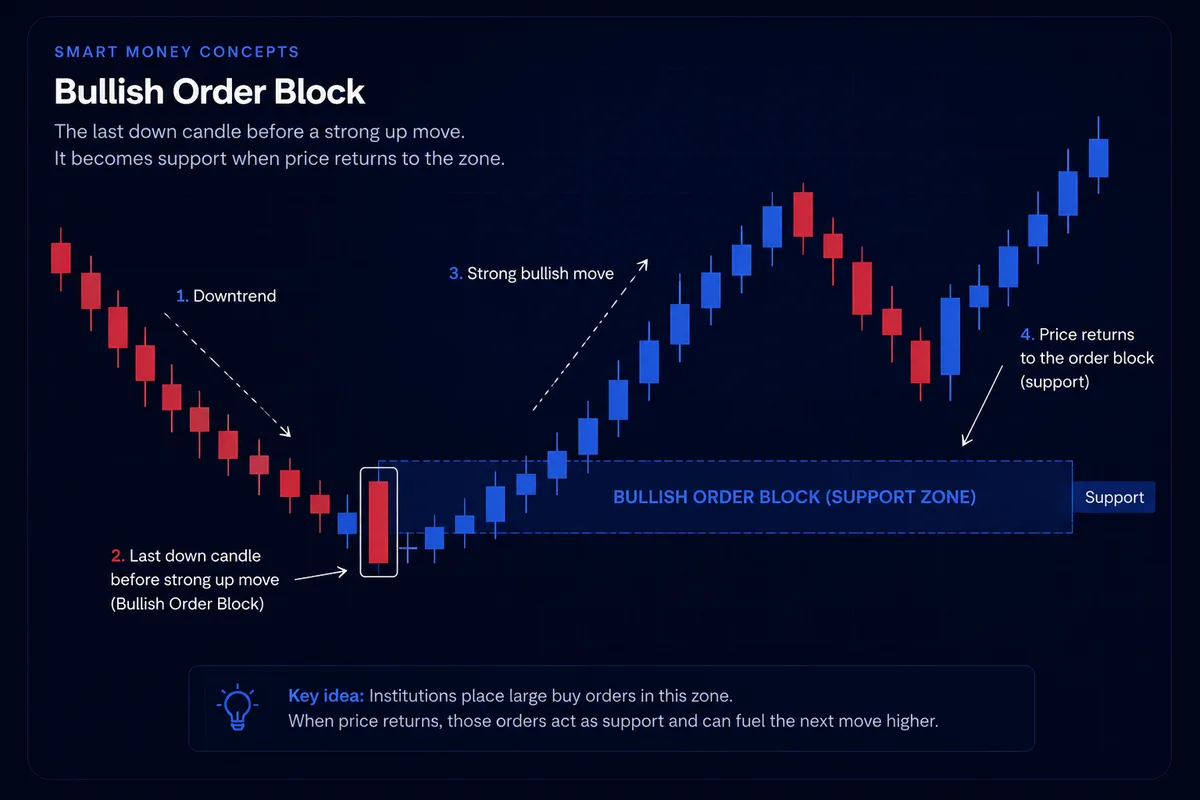
Note: this replaces two overlapping live posts with one canonical.
An order block is the last opposite-direction candle before a strong, impulsive move that breaks market structure. It marks a zone where large institutions likely placed orders, so when price returns to that zone later, it often reacts. Traders use order blocks as high-probability areas to look for entries in the direction of the move that created them.
This guide explains what an order block is, how to tell a bullish block from a bearish one, how to identify a valid block step by step, and how to trade it with confluence while avoiding the common mistakes.
Key takeaways
- An order block is the last down candle before a strong up move (bullish) or the last up candle before a strong down move (bearish).
- A valid order block causes displacement that breaks structure and usually leaves an imbalance behind it.
- A bullish order block acts as support (demand); a bearish order block acts as resistance (supply).
- Order blocks are strongest with confluence: fair value gaps, liquidity, premium/discount, and higher-timeframe direction.
- An unmitigated block (not yet retested) is generally more reliable than one price has already returned to.
What this guide covers
- What is an order block?
- Bullish vs bearish order blocks
- How to identify a valid order block: step by step
- Order blocks with confluence
- Order block vs fair value gap
- Mitigated, unmitigated, and breaker blocks
- Common order block mistakes
- How to mark order blocks on TradingView
- Practise order blocks on a funded account
- Frequently asked questions
What is an order block?
An order block is the final candle in one direction before price makes a sharp, one-sided move in the opposite direction. The idea, drawn from smart money concepts, is that institutions cannot fill large positions in a single click without moving the market, so they build orders in a zone and then push price away from it. That origin zone often holds value when price returns, which is why order blocks are treated as areas of institutional interest.
Bullish vs bearish order blocks
Bullish order block (demand)
A bullish order block is the last down candle before a strong up move that breaks structure. Mark the zone from that candle (commonly its open to low, or the full body-to-wick range). When price pulls back into it, it often finds support and continues higher.
Bearish order block (supply)
A bearish order block is the last up candle before a strong down move that breaks structure. Mark the zone from that candle. When price rallies back into it, it often meets resistance and continues lower.
How to identify a valid order block: step by step
- Find a break of structure. Look for a strong move that breaks a recent swing high or low, showing intent rather than drift.
- Locate the origin candle. Mark the last opposite-direction candle immediately before that move.
- Check for displacement and imbalance. A valid block is followed by fast displacement that usually leaves a fair value gap behind it.
- Draw the zone. Box the candle range and extend it to the right so you can see future retests.
- Wait for the return. Let price come back to the block rather than chasing the initial move.
- Confirm and manage risk. Enter on a lower-timeframe confirmation inside the zone, with a stop beyond the block. See risk management.
Order blocks with confluence
An order block on its own is an area of interest, not a signal. It becomes a high-probability setup when it lines up with other factors:
- Fair value gaps: a block paired with an FVG is a stronger zone.
- Liquidity: blocks that form after a liquidity sweep tend to hold better.
- Divergence: pair a block with SMT divergence at the swing point for extra confirmation.
- Higher-timeframe direction: trade blocks in the direction of the dominant trend.
Order block vs fair value gap
These two smart money tools are related but not the same. The order block is the origin candle where orders sat; the fair value gap is the imbalance created by the move away from it. They often sit right next to each other, and a zone that contains both the block and the gap is one of the cleaner areas to trade.
Mitigated, unmitigated, and breaker blocks
- Unmitigated: price has not yet returned to the block. These are generally the most reliable.
- Mitigated: price has already tapped the block once, so the reaction on a second visit is usually weaker.
- Breaker block: a block that fails and is traded through can flip roles, with a broken bullish block becoming resistance and a broken bearish block becoming support.
Common order block mistakes
- Marking every candle. Without a clear break of structure, a candle is not an order block.
- No displacement. If the move away is slow and overlapping, the block is weak.
- Ignoring the higher timeframe. A block against the dominant trend is far less reliable.
- No confluence. Trading a block with nothing else supporting it lowers the odds.
- Ignoring risk. Even valid blocks fail. Define invalidation beyond the zone before you enter.
How to mark order blocks on TradingView
Identify the break of structure, select the last opposite-direction candle before the move, and use the rectangle tool to box its range. Extend the box to the right and label it bullish or bearish. Marking blocks by hand first builds the judgement needed to ignore low-quality candles that only look like blocks.
Practise order blocks on a funded account
Reading order blocks well takes repetition. You can practise the full process on a simulated funded account and keep a share of the simulated profits once you meet the rules. Explore the 1-step evaluation, instant funding, or the 2-step evaluation to find the route that fits how you trade.
Conclusion
An order block marks where institutions likely built positions before pushing price away, leaving a zone the market often respects on the retest. Confirm a break of structure, mark the origin candle, wait for the return, and act only when fair value gaps, liquidity, or higher-timeframe direction agree. Treated as areas of interest with strict risk control, order blocks are a core building block of a smart money approach.
Frequently asked questions
What is an order block in trading?
It is the last opposite-direction candle before a strong move that breaks structure, marking a zone where large orders likely sat and where price often reacts on a return.
How do I know if an order block is valid?
A valid block causes displacement that breaks a recent swing high or low and usually leaves an imbalance (a fair value gap) behind it. A candle with no clear break of structure is not an order block.
What is the difference between an order block and a fair value gap?
The order block is the origin candle where orders sat; the fair value gap is the imbalance created by the move away from it. They often sit close together, and a zone with both is stronger.
What is an unmitigated order block?
It is a block that price has not yet returned to. Unmitigated blocks are generally more reliable than blocks price has already tapped.
What timeframe is best for order blocks?
Order blocks appear on every timeframe. Many traders set direction on a higher timeframe and refine entries at the block on a lower timeframe.
