









Fair Value Gaps (FVG): How to Find and Trade Them
A fair value gap is a three-candle price imbalance where a strong middle candle moves so fast that it leaves a gap between the wick of the candle before it and the wick of the candle after it. Price o
 Theo TheodorouHead of Trading
A fair value gap is a three-candle price imbalance where a strong middle candle moves so fast that it leaves a gap between the wick of the candle before it and the wick of the candle after it. Price often returns later to rebalance that gap, which is why traders use fair value gaps as high-probability areas to look for entries.
This guide explains what a fair value gap is, how to spot bullish and bearish gaps, how to trade them with confluence, and the mistakes that catch most traders out.
Key takeaways
- A fair value gap (FVG) is an imbalance left by a fast, one-sided move across three candles.
- A bullish FVG sits below price and often acts as support; a bearish FVG sits above price and often acts as resistance.
- The gap is measured between the wick of the first candle and the wick of the third candle, with a large displacement candle in the middle.
- FVGs work best with confluence: market structure, order blocks, liquidity sweeps, and higher-timeframe direction.
- Not every gap fills. Trade FVGs as areas of interest, not guarantees, and always define your risk.
What this guide covers
- What is a fair value gap?
- Bullish vs bearish fair value gaps
- How to trade a fair value gap: step by step
- Fair value gaps with confluence
- Inversion fair value gaps
- Common fair value gap mistakes
- How to mark fair value gaps on TradingView
- Practise fair value gaps on a funded account
- Frequently asked questions
What is a fair value gap?
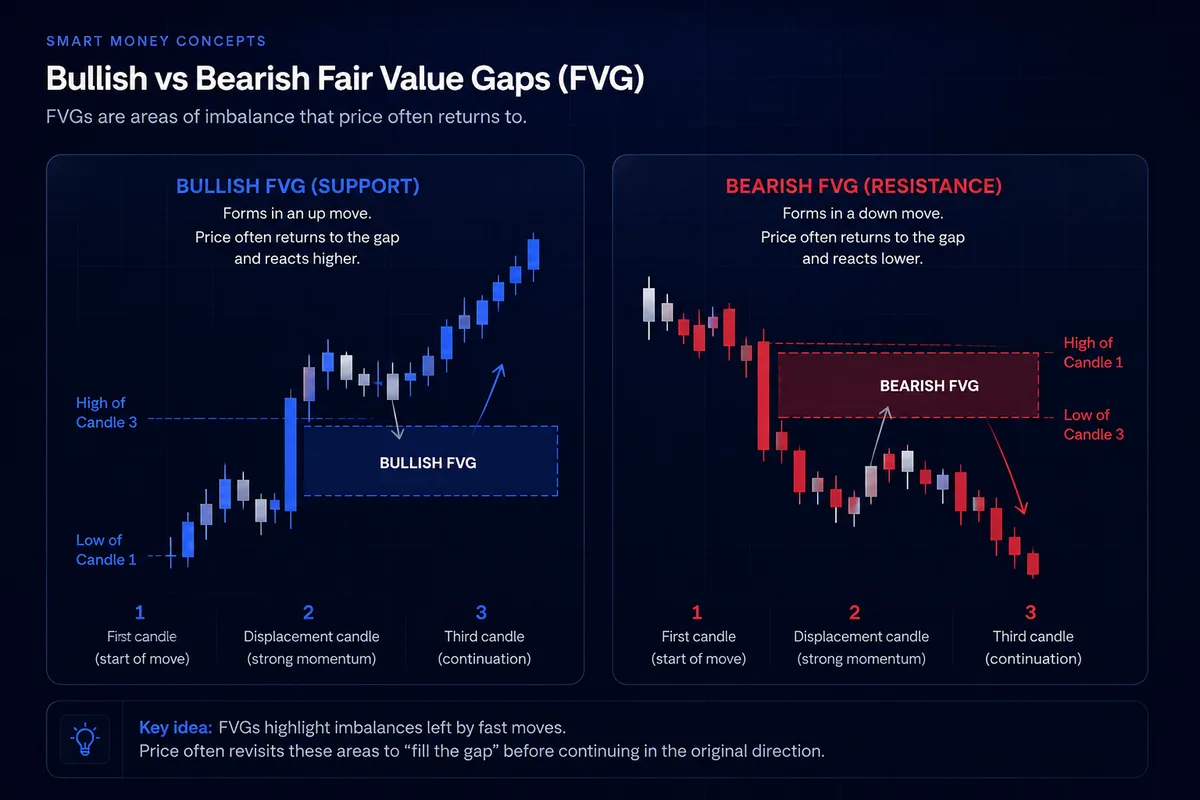
A fair value gap, sometimes called an imbalance, is a range on the chart where price moved in one direction so quickly that buyers and sellers did not trade evenly. On a three-candle sequence, the middle candle is a large displacement candle. The gap is the space between the high of the first candle and the low of the third candle (for a bearish move) or between the low of the first candle and the high of the third candle (for a bullish move).
Because that area was skipped rather than traded through fairly, the market often revisits it later to fill the missing orders. This is the same return-to-imbalance idea behind SMT divergence and other smart money concepts.
Bullish vs bearish fair value gaps
Bullish FVG (forms in an up move)
A bullish fair value gap forms during a strong rally. Mark the gap between the high of the first candle and the low of the third candle. When price pulls back into this zone, it often finds support and continues higher.
Bearish FVG (forms in a down move)
A bearish fair value gap forms during a strong sell-off. Mark the gap between the low of the first candle and the high of the third candle. When price rallies back into this zone, it often meets resistance and continues lower.
How to trade a fair value gap: step by step
- Find displacement. Look for a strong, decisive candle that breaks structure, not slow overlapping candles.
- Mark the gap. Draw a box across the three-candle imbalance as described above.
- Wait for the retracement. Let price return toward the gap rather than chasing the initial move.
- Look for confluence. A reaction is stronger when the FVG lines up with an order block, a liquidity sweep, or a premium/discount level.
- Confirm and enter. Take entry on a lower-timeframe confirmation inside the gap, with a defined invalidation beyond it.
- Manage risk. Size the position so a stop beyond the gap keeps your loss within your plan. See risk management.
Fair value gaps with confluence
FVGs are far more reliable when they agree with the bigger picture. Combine them with:
- Market structure: trade gaps in the direction of the higher-timeframe trend.
- Order blocks: an FVG stacked with an order block is a stronger zone.
- Liquidity: gaps that form after a liquidity sweep tend to hold better.
- Divergence: pair an FVG with SMT or RSI divergence for extra confirmation.
Inversion fair value gaps
When price trades fully through an FVG instead of respecting it, that gap can flip roles. A bullish FVG that breaks can become resistance on the way back up, and a bearish FVG that breaks can become support. This is called an inversion fair value gap, and it is a useful signal that short-term order flow has shifted.
Common fair value gap mistakes
- Trading every gap. Small gaps in choppy conditions fill randomly. Focus on gaps left by clear displacement.
- Ignoring the higher timeframe. A gap against the dominant trend is far weaker.
- No confluence. An FVG on its own is an area of interest, not a signal.
- Front-running the fill. Wait for price to reach and react to the gap rather than anticipating it.
- Ignoring risk. Even good gaps fail. Define invalidation before you enter.
How to mark fair value gaps on TradingView
Use the rectangle tool to box the imbalance across the three candles, extend it to the right, and label it bullish or bearish. Many traders also use a free FVG indicator to auto-detect gaps, but marking them by hand first builds the pattern recognition you need to filter low-quality gaps.
Practise fair value gaps on a funded account
Fair value gaps take screen time to trade well. You can practise the full process on a simulated funded account and keep a share of the simulated profits once you meet the rules. Explore instant funding, the 1-step evaluation, or the 2-step evaluation to find the route that fits how you trade.
Conclusion
A fair value gap marks where price moved too fast to trade fairly, leaving an imbalance the market often returns to. Spot the displacement, mark the gap, wait for the retracement, and only act when structure, order blocks, or liquidity agree. Treated as areas of interest with strict risk control, FVGs become a repeatable edge inside a smart money approach.
Frequently asked questions
What is a fair value gap in simple terms?
It is a gap left on the chart when price moves so quickly in one direction that it skips a price range. The market often returns to that range later to rebalance it.
Do fair value gaps always get filled?
No. Many gaps are filled, but some are not, especially strong gaps that form with the higher-timeframe trend. Treat an FVG as a probable area of interest, not a certainty.
What is the difference between a fair value gap and an order block?
An order block is the last candle before a strong move; a fair value gap is the imbalance created by that move. They often sit close together, and a zone that contains both is stronger.
What timeframe is best for fair value gaps?
FVGs appear on every timeframe. Many traders define direction on a higher timeframe (such as the 1-hour or 4-hour) and refine entries inside the gap on a lower timeframe.
What is an inversion fair value gap?
It is an FVG that price has traded through completely, causing it to flip roles: a broken bullish gap can become resistance and a broken bearish gap can become support.