
 English
 Bahasa Indonesia
 Tiếng Việt
 Español
 Français
 Deutsch
 العربية
 Português
The Six Essential Characteristics of Money
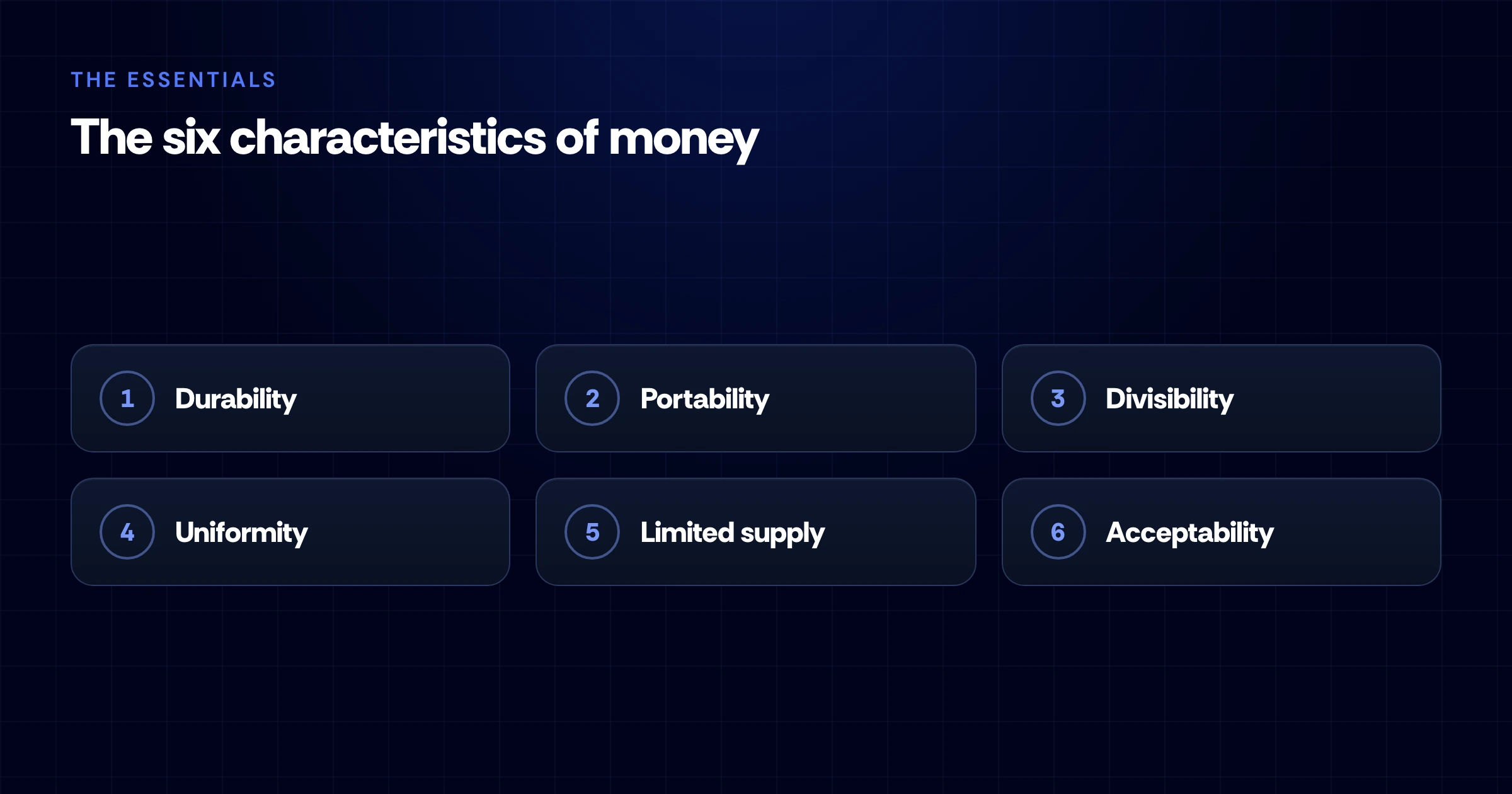
The six characteristics of money are durability, portability, divisibility, uniformity, limited supply, and acceptability. Here's what each means and why it matters.
 Yuna IshikawaCommunity & Support
The six characteristics of money are durability, portability, divisibility, uniformity, limited supply, and acceptability. Anything used as money, from gold coins to modern currencies, works because it meets these six tests. When one of them breaks down, the money loses value or stops being used.
Below is a quick summary, followed by a clear explanation and example of each characteristic, and why they matter to anyone trading currencies.
Key takeaways
- Good money must be durable, portable, divisible, uniform, limited in supply, and widely accepted.
- These characteristics let money act as a medium of exchange, a store of value, and a unit of account.
- Modern currencies are judged by the same six tests as historical money.
What are the characteristics of money?
| Characteristic | Meaning | Example |
| Durability | Lasts without wearing out | Metal coins, polymer notes |
| Portability | Easy to carry and transfer | Banknotes, digital balances |
| Divisibility | Splits into smaller units | 1 dollar into 100 cents |
| Uniformity | Each unit is identical | Every 10 dollar note has equal value |
| Limited supply | Scarce and controlled | Central-bank-managed currency |
| Acceptability | Trusted and accepted by all | National legal tender |
1. Durability
Money must survive repeated use without falling apart. If a currency degraded quickly, it could not reliably store value over time. This is why coins were historically made from hard metals and why many countries now issue polymer banknotes that resist wear, water, and tearing. Digital money takes durability further, since a balance in an account does not physically decay at all.
2. Portability
Money should be easy to carry and transfer. A portable currency lets people trade across distances without hauling heavy goods. Paper notes replaced bulky commodities for this reason, and digital transfers now move value across the world in seconds. Portability is a big part of why global currency markets function so smoothly.
3. Divisibility
Money must divide into smaller units so it can price goods of any value. One US dollar splits into 100 cents, which makes both small and large purchases possible with the same currency. In forex, this fine divisibility is why prices move in tiny increments. If you are new to that idea, see what is a pip in forex.
4. Uniformity
Every unit of a currency must be identical in value and appearance, a quality also called fungibility. One 10 dollar note is worth exactly the same as any other 10 dollar note. Uniformity means people can trade without inspecting each unit, which keeps transactions fast and trustworthy.
5. Limited supply
Money holds value only if it is scarce. If anyone could create unlimited amounts, each unit would quickly become worthless, which is what happens during hyperinflation. Central banks manage the money supply to keep currencies stable. Scarcity is also why some assets, such as gold, have held value for centuries. Explore how relative scarcity plays out in the world's strongest currencies.
6. Acceptability
Finally, money only works if people accept it. A currency backed by trust and law is accepted everywhere within its economy, which is what makes it a reliable medium of exchange. Acceptability is why national legal tender circulates freely, and why widely traded currencies dominate the global market. See how this shapes currency trading.
Why these characteristics matter for traders
For currency traders, these six characteristics explain why some currencies are stable and heavily traded while others are volatile or avoided. A currency with limited, well-managed supply and broad acceptability tends to hold value, while one that loses scarcity or trust can weaken fast. Understanding what makes money strong is a foundation for reading the forex market. Ready to apply it? Start with how to trade forex, then practise on a simulated funded account.
Frequently asked questions
What are the six characteristics of money?
The six characteristics of money are durability, portability, divisibility, uniformity, limited supply, and acceptability.
What is the most important characteristic of money?
Acceptability is often seen as the most important, because money only functions if people trust and accept it. The other five characteristics support that trust.
Why must money have a limited supply?
Scarcity preserves value. If money could be created without limit, each unit would lose value, which is what causes hyperinflation.
Does digital money meet these characteristics?
Yes. Digital currencies are highly durable, portable, and divisible, and mainstream digital money also has controlled supply and broad acceptability.
