
 English
 Bahasa Indonesia
 Tiếng Việt
 Español
 Français
 Deutsch
 العربية
 Português
How to Calculate Lot Size in Forex
Calculating the right lot size in Forex trading is vital for effective risk management. It’s important to consider your account balance and the percentage you’re willing to risk on each trade, typical
 Omar BelhadjHead of Operations
Calculating the right lot size in Forex trading is vital for effective risk management . It’s important to consider your account balance and the percentage you’re willing to risk on each trade, typically between 1% and 2%. Understanding pip value and the distance of your stop-loss can help you find the correct lot size.
What Is a Lot in Forex?
In Forex trading, a lot acts as a standardized unit that defines the size of your trades. One standard lot is equivalent to 100,000 units of the base currency . There are also mini lots (10,000 units), micro lots (1,000 units), and nano lots (100 units). Selecting the appropriate lot size is crucial as it directly influences your risk exposure.
Why Lot Size Matters
Choosing the right lot size isn’t just about maximizing profit — it’s about protecting your capital and ensuring longevity in trading. A well-calculated lot size aligns with your risk tolerance and trading strategy , contributing to more consistent results. Understanding how margin works is also essential for proper lot sizing, especially when using leverage .
Types of Lot Size in Forex
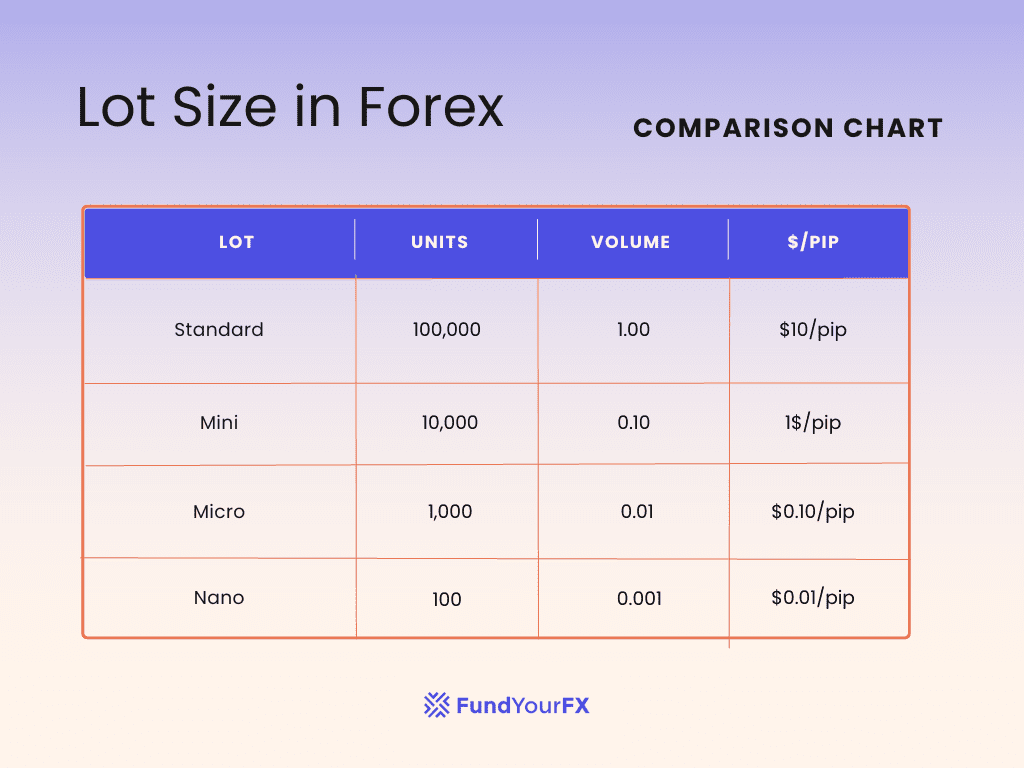
Standard Lot: 100,000 units — typically used by experienced traders due to higher risk/reward potential.
Mini Lot: 10,000 units — popular choice for retail traders with smaller accounts.
Micro Lot: 1,000 units — ideal for beginners or those trading with small capital .
Nano Lot: 100 units — for those who want to minimize risk even further.
How to Calculate Lot Size in Forex?
Calculating lot size involves understanding risk management , pip value , and your stop loss.
Steps to Calculate Your Lot Size
- Determine Your Account Balance.
- Set Your Risk Percentage: 1% to 2% is the standard range.
- Calculate Your Dollar Risk: Account balance × risk percentage. For a $10,000 account at 1%, your dollar risk is $100.
- Assess the Pip Value: For a standard lot on EUR/USD, each pip is worth $10. For a mini lot, $1. For a micro lot, $0.10.
- Determine Stop Loss Distance: Decide how many pips you’re willing to risk. Use support and resistance levels to determine optimal placement.
- Calculate the Lot Size:
Lot Size = Dollar Risk / (Pip Value × Stop Loss Distance)
Risk Management
Effective risk management is vital. Start by assessing how much capital you’re willing to risk on a single trade — typically 1-2% of your total. Understanding the risk-to-reward ratio helps you evaluate each trade’s potential. Creating a trading plan with these calculations keeps you disciplined.
Determining Stop Loss
Setting a stop loss is a vital part of managing trading risk. The stop loss determines the price level at which you’ll exit a losing trade. A tighter stop loss allows for a larger lot size, while a wider stop loss reduces it. Use trailing stops to lock in profits on winning trades.
Example of Lot Size Calculation
Account balance: $10,000. Risk: 2% ($200). Stop loss: 50 pips. Pip value: $10.
Lot Size = ($10,000 × 0.02) / (50 × $10) = 0.4 lots
Accurately determining your lot size is key for effective risk management and safeguarding your trading capital .
What Determines the Lot Size
Three main factors determine your lot size: account balance, risk percentage, and stop loss distance. Know which pairs you’re trading and their typical spread costs , as these affect your pip calculations. During volatile market conditions , consider reducing your lot size to account for wider price swings.
Conclusion
Calculating lot size in Forex plays a key role in managing your trading risk. Always assess your account balance, understand your risk tolerance, and use the formula to find a suitable lot size. These principles apply whether you’re trading with $100 or managing a $100K account . Engage in trading responsibly and continue learning step by step . For those ready to trade with larger capital, consider becoming a funded trader .
Related Risk Management Guides
- What Is a Pip in Forex?
- Risk to Reward Ratio: How to Calculate It
- Stop Loss vs Stop Limit Orders
- What Is Margin in Forex Trading?
- Leverage in Forex Trading
- Forex Money Management Strategies
