
If you’re thinking about day trading with a $25,000 account, it’s helpful to have a clear picture of what’s possible and what to watch out for. Many traders aim to earn about 1% to 2% per day, which would be $250 to $500 daily on a $25,000 account. However, real-life results vary and often depend on your trading style, experience, and the overall market conditions. How much can you make day trading with $25000? Let’s discuss it in this article.
Why Do You Need 25K to Day Trade?

You need $25,000 to day trade because of the Pattern Day Trading (PDT) rule, a regulation created by FINRA to protect investors from taking on too much risk. According to this rule, if you have less than $25,000 in your margin account, you are limited in how many day trades you can make within a five-day period. If you’re starting with a smaller budget, read our guide on day trading with $1,000 to understand what’s realistic at that level.
Day Trading Rules Under 25K
If your trading account balance is under $25,000, strict day trading rules apply due to the Pattern Day Trader (PDT) Rule. This rule states that you cannot make more than three day trades within a rolling five-business-day period. If you exceed this limit, your account will be flagged and your trading will be restricted. An alternative approach is to trade with a proprietary trading firm, which provides funded capital without the PDT restriction.
Setting Realistic Expectations for a $25,000 Day Trading Account
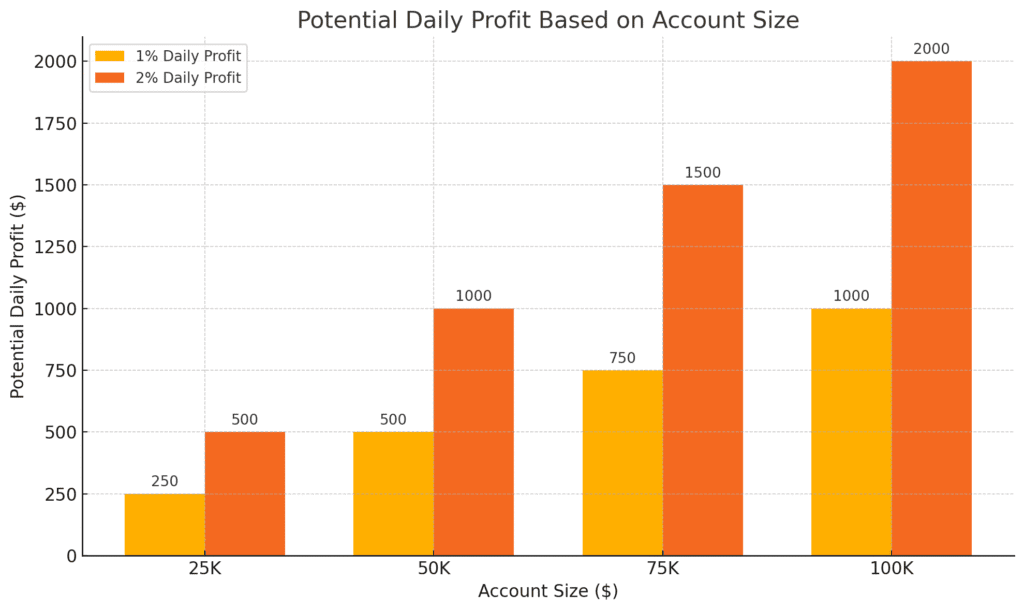
If you’re starting day trading with a $25,000 account, it’s important to set practical goals and understand the risks before jumping in. Some traders hope to make between $250 and $500 a day, which would be about a 1% to 2% return daily when things go well. However, most traders see annual profits closer to $5,000 to $12,500, since losses and inconsistent days are part of the process. It’s wise to be aware of risk management principles, as they can protect your capital during volatile conditions.
Success in day trading isn’t just about the numbers — it depends a lot on your mindset. Handling the pressure of rapid market changes and sticking to your plan even when emotions run high is key. Many people underestimate how much time and attention trading takes. One way to build a strong foundation is by focusing on setting proper risk-to-reward ratios so you can control losses and avoid overexposing your account.
The markets are unpredictable, so being able to adapt quickly makes a real difference. Learning never stops in trading. Even experienced traders keep refining their trading strategies and managing their risk to avoid big losses.
Factors That Influence Day Trading Profits
Many new traders get excited by the promise of quick profits, but your real results depend on several important factors working together. Market volatility is one of the biggest influences. When prices move quickly, there’s a chance to make more money in a short time. However, these swings can also lead to bigger losses if you’re on the wrong side of a trade.
Trading psychology matters just as much as technical skills. Staying calm and making decisions without letting emotions take over can be the difference between building your account and wiping it out. For example, traders who panic during sudden drops often end up selling at the worst time, while those with a solid plan stick to their strategy. Understanding the impact of economic indicators and central bank decisions on price movements can also help traders make more informed decisions.
Using borrowed funds, often called margin, can increase both your gains and your losses. For instance, on a $25,000 account, trading with margin lets you control larger positions, but it also means any mistake is much more costly.
Your trading strategy also plays a direct role in your results. The best day trading strategies are based on clear rules and are flexible enough to adjust when market conditions change.
Finally, liquidity — how easy it is to buy or sell — can impact your profits. Stocks and currency pairs with high trading volume make it easier to enter and exit trades quickly.
Smart Ways to Grow a $25,000 Day Trading Account
Day trading can bring quick profits, but growing a $25,000 account takes more than just luck. A well-thought-out trading plan and strong self-control make a big difference. Focusing on high-volatility stocks can give you more chances to earn in a short time.
Many traders use scalping, which means making several small trades to collect small gains that add up by the end of the session. Understanding how support and resistance influence price movement can help you time your entries and exits more effectively within each trading day.
Keep an eye on tools like moving averages and the RSI indicator to help you decide when to buy and sell. Following the market’s trend direction, instead of fighting it, can improve your odds of success.
Managing your emotions is just as important as choosing the right stock. Sticking to your original plan — even if the market gets unpredictable — helps prevent rash decisions that can lead to losses. Learn more about overcoming FOMO and revenge trading.
It’s also helpful to review your trades each day. Writing down what worked and what didn’t can highlight patterns, helping you make better choices in the future.
Managing Risk and Avoiding Significant Losses
Growing a $25,000 day trading account takes more than just picking stocks that go up. Protecting your money is just as important as finding the next big winner.
Why Stop Losses Matter
Setting a stop loss on every trade means you decide in advance how much you’re willing to lose if the market moves against you. For example, if you never risk more than 2% of your account on a single trade, even a few losses in a row won’t wipe out your entire balance. You can also use trailing stop losses to lock in profits as the price moves in your favor.
Trade Sizing and Risk Per Trade
Adjust how much you buy or sell based on your account size and how risky the trade is. Understanding proper position sizing is key. If you have $25,000, risking $250–$500 on each trade (1–2%) is a common approach.
Sticking to Your Plan
It’s easy to let fear or excitement take over when trading. Following your plan, even during losing streaks, helps you avoid making snap decisions. Keep a trading journal to review your decisions and spot patterns that are working — or not. Avoiding the most common trading mistakes will keep you ahead of the majority.
Key Steps for Managing Risk
- Always use stop losses to limit potential losses.
- Keep your position size in line with your risk tolerance.
- Follow your trading plan to avoid emotional trades.
Another important practice is to limit risk per trade to a small percentage of your trading capital, which is a proven way to preserve your account during volatile markets.
Alternatives to the $25K Requirement
If you don’t have $25,000 to meet the PDT rule, there are several alternatives. Many traders join no evaluation prop firms that provide funded accounts without requiring the $25K minimum. You can also pass a prop firm challenge to prove your skills and trade with the firm’s capital. If you’re looking for a larger account, explore options for day trading with $100K through funded trading programs.
Example Trading Scenarios

| Win Rate | Wins (out of 100 trades) | Losses (out of 100 trades) | Earnings from Wins | Losses from Losses | Net Profit/Loss |
| 50% | 50 | 50 | $25,000 (50 × $500) | -$12,500 (50 × -$250) | $12,500 profit |
| 60% | 60 | 40 | $30,000 (60 × $500) | -$10,000 (40 × -$250) | $20,000 profit |
| 70% | 70 | 30 | $35,000 (70 × $500) | -$7,500 (30 × -$250) | $27,500 profit |
| 40% | 40 | 60 | $20,000 (40 × $500) | -$15,000 (60 × -$250) | $5,000 profit |
| 30% | 30 | 70 | $15,000 (30 × $500) | -$17,500 (70 × -$250) | -$2,500 loss |
Conclusion
Day trading with a $25,000 account is possible, but your results will depend on your strategy, risk tolerance, and experience. Many active traders aim for daily gains of about 1% to 2%, which equals roughly $250 to $500 a day. However, these numbers can change quickly depending on market swings, unexpected news, and how disciplined you are with your trades.
Trading fees, taxes, and losing trades will also reduce your profits. That’s why having a clear trading plan and sticking to your risk limits is so important. If you’re just starting, consider practicing with a demo or paper trading account before risking your full capital.