

When trading forex, it’s essential to recognize forex trading patterns charts such as flags, pennants, head and shoulders, and double tops. These formations can provide insights into market sentiment and assist in predicting price movements, helping you determine the right moments to enter or exit trades. To achieve consistent results, it’s important to not only spot these patterns but also to confirm them effectively. If you’re looking to sharpen your trading strategy and sidestep common mistakes, taking a closer look at these fundamental patterns is crucial.
Understanding patterns like the head and shoulders can signal potential trend reversals, while double tops and bottoms may indicate upcoming price changes. Flags and pennants often suggest continuation, providing traders with opportunities to ride the prevailing trend.
Understanding the Main Types of Forex Chart Patterns

When you start analyzing Forex markets, it’s essential to recognize chart patterns that generally fit into three primary categories: continuation, reversal, and bilateral patterns. If you’re new to reading charts, start with our guide on how to read candlestick charts or learn how to read charts without indicators.
Continuation Patterns
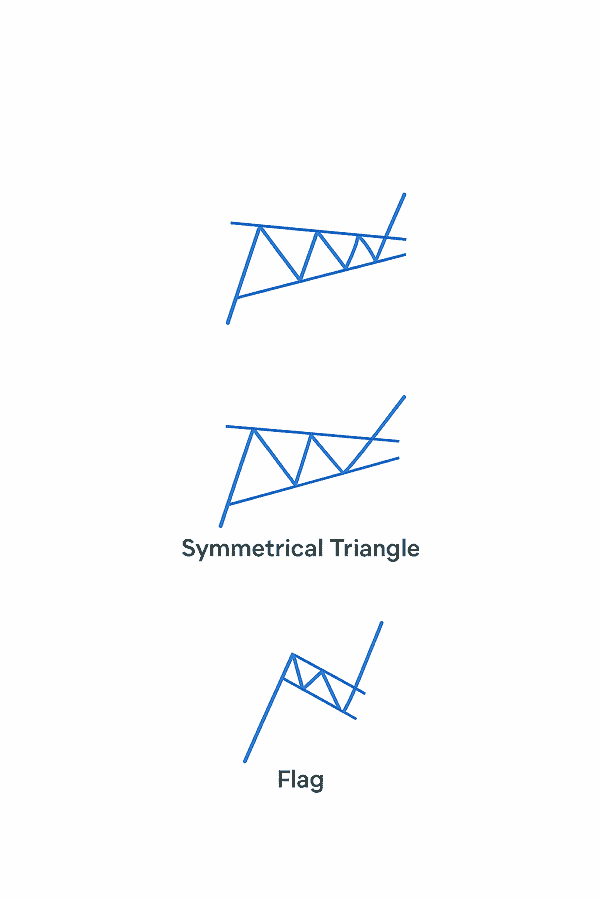
Patterns like flags and pennants indicate that the existing trend is likely to continue after a short period of consolidation. Price compression often precedes these breakouts, making it important to recognize consolidation patterns early.
Reversal Patterns
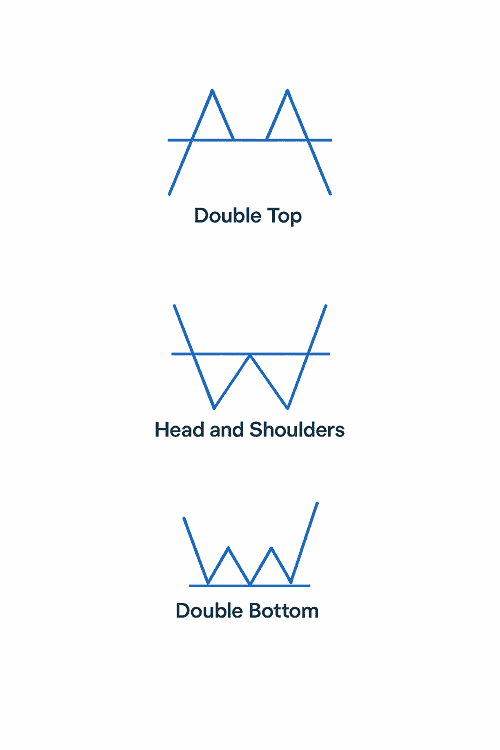
Reversal patterns, such as the Head and Shoulders pattern, signal a potential change in the trend’s direction. The Quasimodo pattern is another powerful reversal formation that many traders overlook. Traders should exercise caution and seek confirmation — using tools like RSI divergence or MACD divergence before making any trading decisions.
Bilateral Patterns
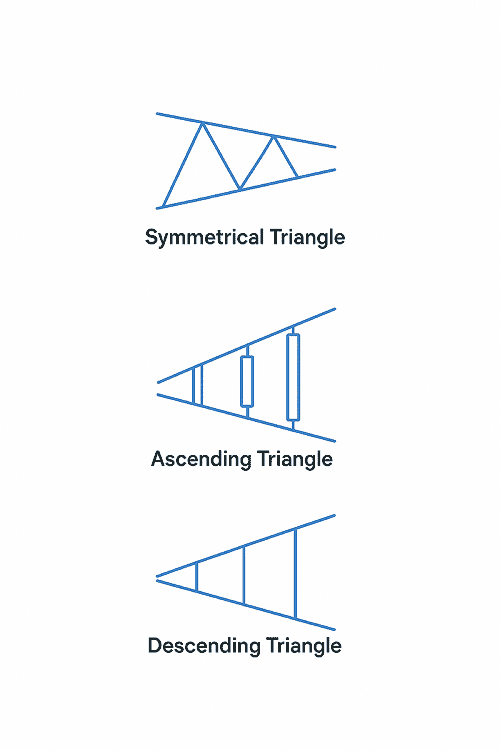
Bilateral patterns, including symmetrical triangles, suggest that price could break out in either direction. This situation necessitates setting orders on both sides of the pattern. Make sure you have stop-loss orders placed to protect your capital regardless of which direction the breakout occurs.
What is The Best Pattern For Trading Forex?
There isn’t a single “best” pattern for trading forex, as the most effective one depends on your trading style, the currency pair, and current market conditions. However, some patterns are widely favored for their reliability, such as the Head and Shoulders, Double Top and Double Bottom, various types of Triangles, Flags and Pennants, and simple candlestick patterns like the Shooting Star. Remember, no pattern is foolproof, so combine them with solid risk management for best results.
Key Reversal Patterns Every Trader Should Know
To successfully navigate the Forex market, it’s vital to grasp key reversal patterns.
One notable pattern is the Head and Shoulders, which signals a transition from bullish to bearish sentiment when the price falls below the neckline; it boasts a success rate of about 75%. Recognizing this pattern can be powerful when combined with trend following strategies for confirming broader market direction.
In contrast, the Inverse Head and Shoulders suggests a possible bullish reversal, achieving an 80% success rate.
The Double Top, which consists of two peaks, indicates bearish reversals if the price breaks through support. Conversely, the Double Bottom, represented by two troughs, points to bullish reversals when resistance is broken.
Understanding Smart Money Concepts can also help you see how institutions create and exploit these patterns through liquidity grabs.
Essential Continuation Patterns for Trend Trading
Understanding continuation patterns is vital for taking advantage of ongoing trends. Patterns like flags and pennants indicate that a trend is likely to continue following a short period of consolidation. A bullish flag has a notable 75% success rate for upward breakouts.
Developing a solid trading plan that incorporates these patterns can help traders set clear entry and exit points and manage risk more effectively.
Another useful pattern is the symmetrical triangle, characterized by converging trendlines. Understanding price compression helps you anticipate when these breakouts are about to occur.
Effective Strategies for Trading Chart Patterns
Here are effective strategies for trading chart patterns:
1. Identify the Pattern Correctly
- Common Patterns: Head and Shoulders, Double Top/Bottom, Triangles, Flags, Pennants, Rectangles, Cup and Handle.
- Confirmation: Wait for the pattern to fully form and confirm.
2. Entry Strategies
- Breakout Entry: Enter the trade when the price breaks out of the pattern.
- Retest Entry: Wait for the price to retest the breakout level for confirmation.
3. Use Volume Spread Analysis for Confirmation
- Volume Spike: A notable increase in volume on the breakout adds validity to the pattern.
- Low Volume: Breakouts on low volume are more likely to be false.
4. Set Clear Targets
- Measured Move Technique: Measure the height of the pattern and project it from the breakout point.
- Partial Profit-Taking: Consider taking profits at intermediate support/resistance levels.
- Stop-Loss Placement: Place stops just outside the pattern’s invalidation point. Consider trailing stops to lock in profits.
- Position Sizing: Only risk a small percentage of your capital. Use our lot size calculator guide to determine the right amount.
6. Combine with Other Indicators
- Use momentum indicators like RSI divergence or MACD divergence to confirm the pattern’s signal.
- The Wyckoff Method provides another framework for understanding market structure behind these patterns.
7. Adapt to Market Context
- Chart patterns work best in trending markets. Avoid trading patterns in choppy, sideways markets.
- Use higher timeframes for more reliable signals. Trade during the best forex trading sessions for optimal liquidity.
| Langkah | Action |
| Pattern ID | Spot reliable and complete chart patterns |
| Entry | Enter on breakout and/or confirmed retest with volume confirmation |
| Stop-Loss | Place stops just beyond invalidation points |
| Target | Use measured move; consider partial profit at key levels |
| Confirmation | Use volume and other technical indicators |
| Manajemen Risiko | Limit position size, stick to a predetermined risk per trade |
Common Challenges and Tips for Pattern Recognition

While having effective strategies can significantly boost your trading outcomes, consistently identifying chart patterns comes with its own challenges. Market noise can often blur clear formations.
- Prioritize Clear Patterns: Focus on well-defined patterns such as Head and Shoulders or Double Tops.
- Analyze Multiple Timeframes: Understand forex market hours and look at patterns across longer timeframes to confirm signals.
- Confirm Breakouts: Always verify breakouts with volume and price action to minimize the risk of false breakouts. Watch out for bear traps that can deceive traders.
Recognizing market structure through Smart Money Concepts can further enhance your pattern recognition by helping you identify key zones shaped by institutional activity. Managing your trading psychology is equally important — avoid letting FOMO push you into low-quality setups.
Trading Chart Patterns Summed up
| Category | Pattern | Signal Direction |
| Reversal | Head and Shoulders (Top) | Bearish |
| Head and Shoulders (Inverse) | Bullish | |
| Double Top | Bearish | |
| Double Bottom | Bullish | |
| Triple Top/Bottom | Depends on context | |
| Continuation | Symmetrical Triangle | Follows trend |
| Ascending Triangle | Bullish | |
| Descending Triangle | Bearish | |
| Flag | Bullish or Bearish | |
| Pennant | Bullish or Bearish | |
| Rectangle | Follows prior trend | |
| Bilateral | Symmetrical Triangle | Bullish or Bearish |
| Other | Cup and Handle | Bullish |
| Rounding Bottom | Bullish |
Kesimpulan
Mastering forex trading patterns can significantly improve your ability to spot market trends and make smart trading choices. Validate these patterns through volume analysis and an understanding of market structure. Regular practice and keen observation will help you identify trustworthy setups. For those looking to apply these patterns with larger capital, consider becoming a funded trader through a prop firm.
Related Chart Pattern Guides
- Head and Shoulders Pattern: How to Trade This Reversal Setup
- Pola Double Top dan Double Bottom
- Flag Patterns: How to Spot Bull and Bear Flags
- Quasimodo Pattern: How to Spot and Trade This Reversal
- Shooting Star Candlestick: How to Spot Bearish Reversals
- Price Compression: How to Spot and Trade Breakouts