
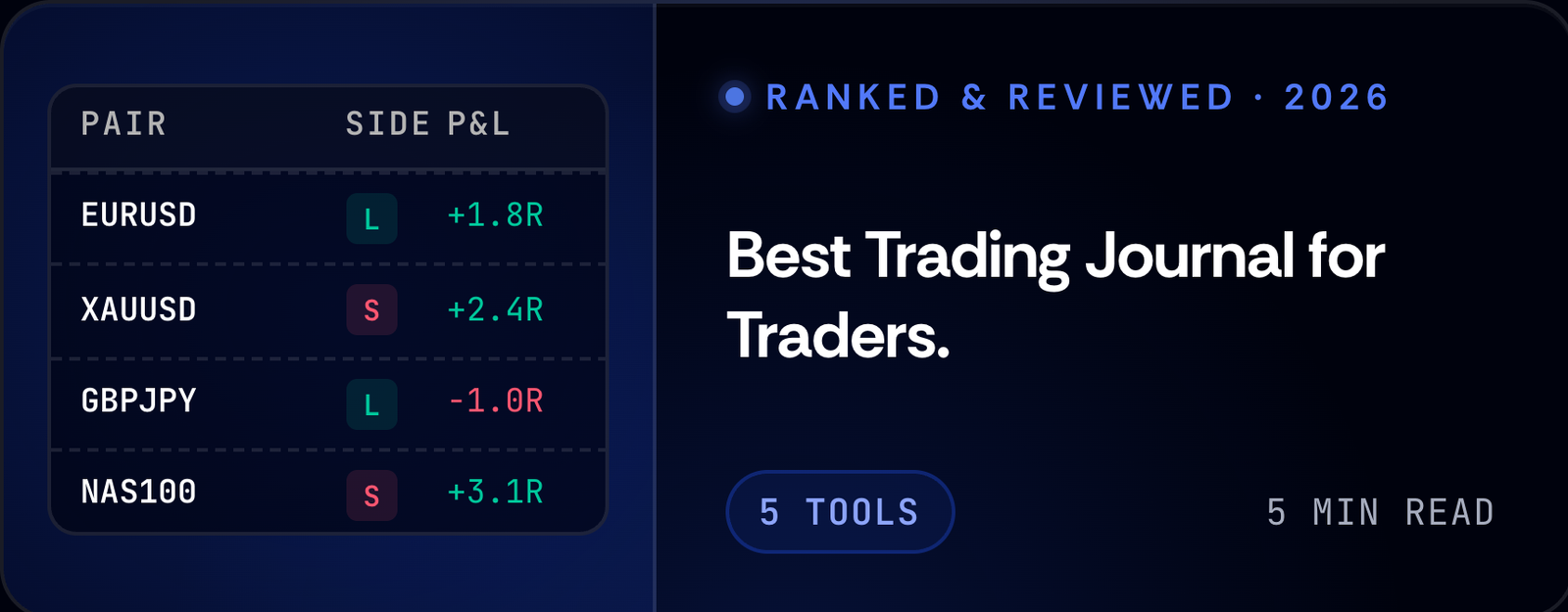
If you want to become a consistently profitable trader, keeping a trading journal is non-negotiable. It’s how you identify what’s working, fix what isn’t, and build the kind of discipline that funded trading firms look for.
But not all trading journals are built the same. Some are just spreadsheets. Others are fully featured platforms with analytics, charts, and performance tracking built in. We’ve reviewed the best trading journals available in 2026 to help you find the right one for your style and goals.
Why Every Trader Needs a Trading Journal
Most traders who fail do so because they repeat the same mistakes without realising it. A trading journal forces you to record every trade — your entry, exit, reasoning, emotions, and outcome. Over time, patterns emerge that are impossible to spot any other way.
For funded traders specifically, a journal is even more important. Prop firms like FundYourFX fund traders based on consistent, disciplined performance. Understanding your edge — and protecting your drawdown — requires the kind of self-analysis only a journal provides.
The Best Trading Journals in 2026
1. TraderWaves — Best Overall Trading Journal
TraderWaves is our top pick for the best trading journal in 2026. It’s a purpose-built platform designed specifically for active traders who want more than just a spreadsheet — combining detailed trade logging with performance analytics, psychology tracking, and a clean, intuitive interface that doesn’t get in the way.
Why TraderWaves stands out:
- Detailed trade entry with entry/exit price, position size, risk, and notes
- Automatic performance analytics — win rate, average R, profit factor, drawdown curves
- Psychology and emotion tracking per trade — identify patterns in your mindset
- Tag-based filtering — analyse performance by setup type, session, pair, or market condition
- Clean dashboard with portfolio-level overview
- Built for both forex and futures traders
- Works seamlessly alongside MetaTrader 5 and MatchTrader workflows
| Feature | TraderWaves |
|---|---|
| Trade logging | ✅ Full |
| Performance analytics | ✅ Advanced |
| Psychology tracking | ✅ Yes |
| Tag & filter system | ✅ Yes |
| Free plan | ✅ Available |
| Mobile-friendly | ✅ Yes |
Best for: Forex and funded traders who want a complete performance analytics platform, not just a place to log trades.
👉 Get Started With TraderWaves
2. Tradervue — Best for Detailed Trade Reporting
Tradervue is one of the most established trading journal platforms available. It offers deep reporting tools and import integration with many brokers, making it popular with equities and futures traders who want granular trade analysis.
- Automatic trade import from many brokers
- Detailed P&L analysis with charts and breakdowns
- Shared journal option for transparency and community feedback
- Strong reporting on execution quality
Watch out for: The free plan is quite limited — only 3 trades per day. The interface feels dated compared to newer tools like TraderWaves. Less suited to forex traders.
Best for: Equities and futures traders who import trades from US brokers and want detailed execution reports.
3. Edgewonk — Best Desktop Journal for Serious Traders
Edgewonk is a downloadable trading journal software with a strong focus on trade psychology and strategy improvement. It’s particularly popular with traders who want deep self-analysis tools and are willing to pay a one-time fee for lifetime access.
- One-time purchase — no monthly subscription
- Strong psychology and habits tracking section
- Tilt analysis — identifies emotional patterns that cost you money
- Strategy backtesting integration
Watch out for: Desktop software only — no mobile or web app. Steeper learning curve for new traders. No broker auto-import.
Best for: Experienced traders who prefer a one-time payment model and want deep psychology analysis tools.
4. TradesViz — Best Free Trading Journal
TradesViz offers one of the most generous free plans in the market, making it an excellent starting point for newer traders who aren’t ready to commit to a paid tool yet. It supports auto-import from over 100 brokers and has solid analytics even on the free tier.
- Generous free tier — import unlimited trades
- Supports 100+ broker integrations
- Good analytics including heatmaps and calendar views
- Supports stocks, options, futures, and forex
Watch out for: Interface can feel overwhelming for beginners. Advanced analytics and features require a paid plan.
Best for: Traders who want a free journal with solid analytics and broad broker support.
5. Notion Trading Journal (Free Template)
For traders who prefer full control over their data and don’t want to pay for a dedicated platform, a Notion trading journal template is a popular and completely free option. Notion’s flexibility lets you customise every field, add your own tags, and build a setup that perfectly fits your trading style.
- 100% free
- Fully customisable — build exactly what you need
- Many free templates available from the trading community
- Available on all devices
Watch out for: No automatic analytics — you have to build everything manually. Time-consuming to set up and maintain. No broker integrations.
Best for: Beginners or traders who prefer a hands-on, DIY approach and want zero cost.
Side-by-Side Comparison
| Journal | Best For | Free Plan | Auto-Import | Analytics | Mobile |
|---|---|---|---|---|---|
| TraderWaves | Overall — forex & funded traders | ✅ Yes | ✅ Yes | Advanced | ✅ Yes |
| Tradervue | Detailed reporting — equities | ⚠️ Limited | ✅ Yes | Strong | ✅ Yes |
| Edgewonk | Psychology-focused traders | ❌ No | ❌ No | Advanced | ❌ No |
| TradesViz | Free journal with analytics | ✅ Generous | ✅ 100+ brokers | Good | ✅ Yes |
| Notion Template | DIY / beginners | ✅ Free | ❌ No | Manual only | ✅ Yes |
What to Look for in a Trading Journal
1. Easy Trade Logging
The best journal is the one you’ll actually use consistently. If logging a trade takes more than 2 minutes, you’ll start skipping entries. Look for a clean, fast logging interface — ideally with broker auto-import so your trades are pulled in automatically.
2. Performance Analytics
Raw trade data isn’t useful on its own. You need analytics that surface your win rate, average risk-reward, profit factor, best and worst performing setups, and drawdown curves. Tools like TraderWaves do this automatically — giving you a dashboard view of your edge.
3. Psychology Tracking
The difference between a losing trader and a funded trader is often mindset, not strategy. A good journal lets you tag trades with emotions — fear, overconfidence, revenge trading — so you can identify which mental states are costing you money.
4. Tag and Filter System
Not all your setups perform equally. A tag system lets you filter your results by setup type, session, currency pair, or market condition — so you can double down on what works and cut what doesn’t.
5. Accessibility
A web-based or mobile-accessible journal means you can log trades and review performance anywhere. Desktop-only tools like Edgewonk are powerful but limit where and when you can use them.
How to Use a Trading Journal as a Funded Trader
If you’re trading with a funded account from a firm like FundYourFX, your journal takes on extra importance. Here’s how to use it effectively:
- Log every trade immediately — don’t rely on memory. Record entry, exit, size, setup, and reasoning the moment the trade closes.
- Note your emotional state — were you trading with a clear head, or were you frustrated after a loss? Tracking this reveals your biggest leaks.
- Review weekly, not just daily — daily fluctuations are noise. Weekly reviews reveal actual patterns.
- Tag by setup type — if your breakout trades consistently underperform your pullback trades, that’s critical information.
- Track drawdown separately — funded accounts have drawdown limits. Your journal should show you exactly where you are relative to your limit at all times.
- Use analytics to remove bias — you will always have a gut feeling about which setups work. Your journal data will often tell a different story. Trust the data.
अक्सर पूछे जाने वाले प्रश्नों
What is the best trading journal for forex traders?
TraderWaves is the best trading journal for forex traders in 2026. It’s built with forex and funded traders in mind, offers advanced analytics, psychology tracking, and a clean interface that makes daily trade logging straightforward. It also integrates well with MetaTrader 5 and MatchTrader workflows commonly used by prop firm traders.
Is there a free trading journal?
Yes — both TraderWaves and TradesViz offer free plans. TraderWaves is our top pick for a free trading journal as it provides analytics and performance tracking without needing a paid subscription to get started. Notion trading journal templates are also completely free if you prefer a DIY approach.
Do prop firms require you to keep a trading journal?
Prop firms don’t typically require a journal, but the best funded traders almost always keep one. It’s the primary tool for identifying your edge, managing risk, and building the consistency that funded trading demands. If you’re trading with a firm like FundYourFX, a journal is one of the most effective tools you have for protecting your account and maximising your payout.
What should I record in a trading journal?
At minimum: entry price, exit price, position size, setup type, direction (long/short), result (win/loss), and P&L. For a more powerful journal, also add: risk amount, emotional state, pre-trade notes, post-trade review, and tags for setup category and session. Tools like TraderWaves capture all of this in a structured format automatically.
Our Verdict
For forex traders and funded traders in 2026, TraderWaves is the clear best trading journal available. It combines everything you need — fast trade logging, advanced analytics, psychology tracking, and a clean interface — in a platform purpose-built for the way modern traders work.
If you’re looking for a free option with strong analytics, TradesViz is a solid alternative. And if you prefer a desktop tool with deep psychology features, Edgewonk is worth considering.
Whatever journal you choose, the most important thing is consistency. Log every trade. Review every week. Let the data guide your decisions.
And when you’re ready to trade with real funded capital — FundYourFX has you covered.