

In the world of Forex trading, traders constantly seek tools that provide a competitive advantage. One such tool is the Relative Strength Index (RSI) divergence. This concept acts as a vital indicator for potential trend reversals, enabling traders to make informed decisions.
Understanding the Basics of RSI
The RSI is a momentum oscillator that measures the speed and change of price movements. It ranges from zero to 100 — above 70 suggests overbought conditions, while below 30 indicates oversold. Learning to read candlestick charts alongside RSI enhances your analysis.
Understanding RSI Divergence
RSI divergence occurs when the price of a currency pair moves in the opposite direction to the RSI indicator.
Bullish Divergence
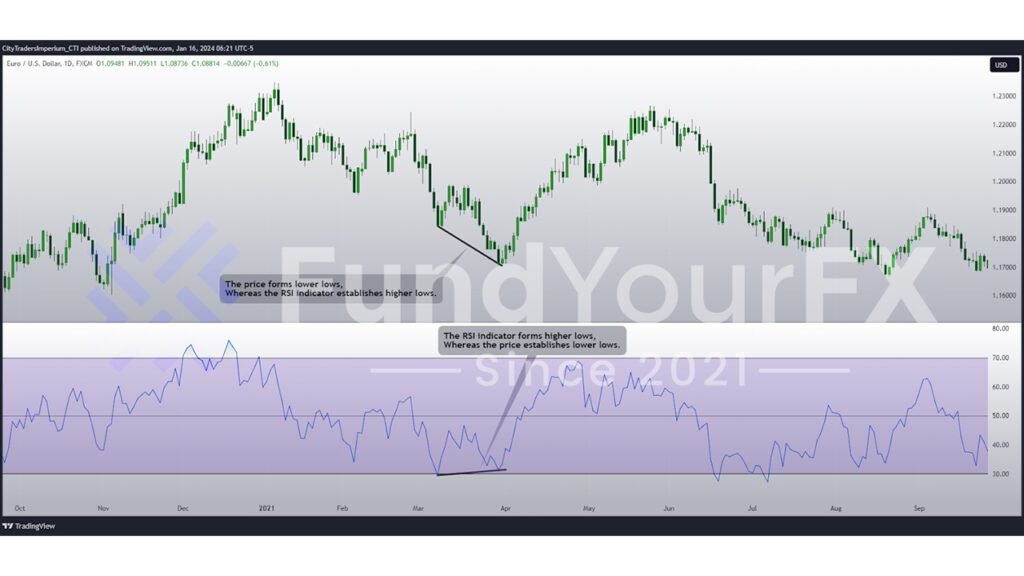
Bullish Divergence occurs when the price reaches a new low, but the RSI forms a higher low. This suggests weakening downward momentum — a potential bullish reversal. This concept is central to Smart Money Concepts where institutional traders often accumulate positions during bullish divergence.
Bearish Divergence
Bearish divergence happens when the price reaches a new high, but the RSI forms a lower high. This indicates weakening upward momentum — a warning that a reversal may be approaching. Patterns like head and shoulders or double tops often form alongside bearish RSI divergence.
Spotting RSI Divergence in Action
To effectively spot RSI divergence, watch for the price making successive higher highs while the RSI forms lower highs. This is also related to SMT divergence, where correlated assets show opposing price structures.
Incorporating RSI Divergence into Your Strategy
- Confirmation through Price Action: Complement RSI divergence with chart patterns, support and resistance levels, or price action analysis.
- Consider Multiple Timeframes: Divergence on longer timeframes carries more weight. Trade during the most active sessions for the best forex pairs.
- Combine with Other Indicators: Merge RSI divergence with MACD divergence, moving averages, or the Wyckoff Method for a more complete view.
- Prioritize Risk Management: Set stop-loss orders wisely. Use proper position sizing and maintain favorable risk-to-reward ratios.
Is RSI or MACD Better for Divergence?
Both RSI and MACD can effectively identify divergence. Some traders prefer RSI for its straightforwardness, while others lean towards MACD for its capability to capture both trends and momentum. Volume Spread Analysis provides another lens for confirming divergence signals.
Does RSI Divergence Always Work?
Like any trading tool, RSI divergence is not infallible. Watch out for bear traps and false signals. Use divergence as a supportive tool within a broader trading plan — not a standalone strategy. Managing your trading psychology prevents overconfidence when divergence signals appear to confirm your bias.
Conclusión
RSI divergence is an invaluable tool for Forex traders. By incorporating it into a comprehensive strategy alongside proper money management, you can navigate currency markets effectively. Continuous practice and adaptation are essential. For those wanting to apply divergence strategies with larger capital, consider becoming a funded trader through a prop firm.